Home/Products/DS Performance
Flagship · EFB Performance

Aircraft performance, from every certified source

Our industry-leading EFB performance software is recognised by operators and authorities worldwide. It is part of the next-generation suite of apps for pilots, dispatchers and flight operations engineers.

Capabilities

The fastest calculations available

Whether a type is built on a manufacturer SCAP module, performance table lookups or digitised AFM data, DS Performance runs takeoff and landing calculations on the EFB or in the back office, fully offline, always with the accuracy of the certified source behind it.
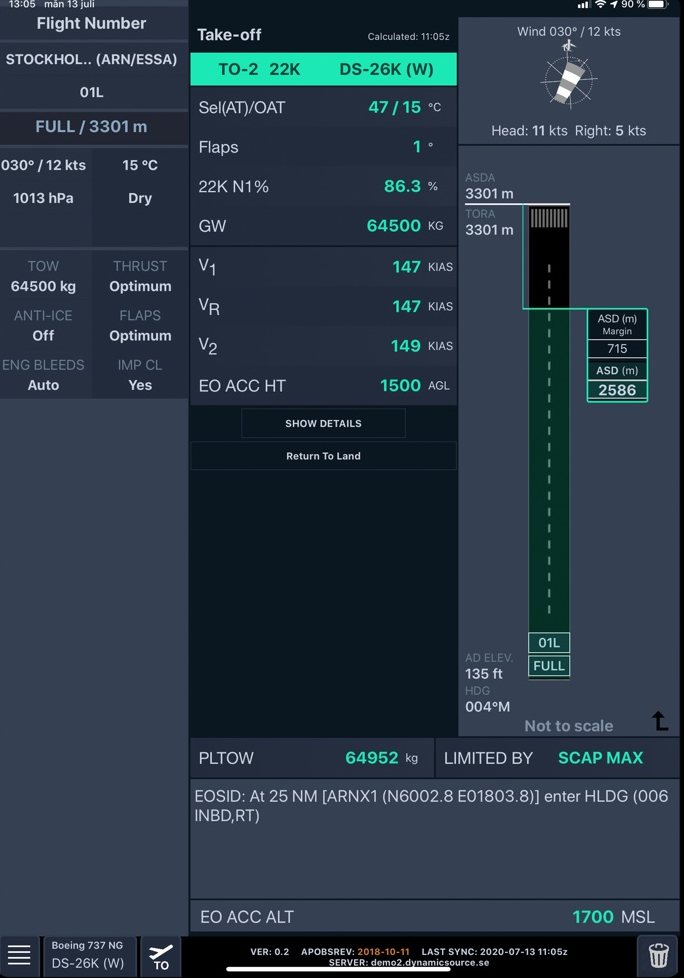
  • Optimised offline takeoff calculations on the best certified data source for each type
  • Landing calculations for dispatch and in-flight / enroute
  • Manipulate critical parameters according to NOTAMs
  • Live METAR feed auto-populates inputs with a simple tap
  • Customisable verifiers reduce input errors
DS Performance takeoff calculation, actual application screenshot
CALCULATION ENGINE · SOURCES
SCAP MODULE
First & second principle
IATA STD
RPM TABLES
RTOW lookups
DIGITISED
AFM DATA
Certified charts
DIGITISED
CUSTOM
Supplements & STCs
VALIDATED
Calculation engine

One engine, every certified data source

DS Performance is not tied to a single source of performance data. Every aircraft type is engineered onto the best certified basis available for it. Where a manufacturer module does not exist, or a different basis suits your operation better, the same engine runs on other certified sources. Your crews see one application and one workflow across the whole fleet.

  • Manufacturer SCAP modules: performance software built to the IATA standard, as first-principle modules solving the certified performance model directly, or second-principle modules computing on the manufacturer’s pre-calculated data
  • RPM table lookups: route performance manuals and regulated takeoff weight (RTOW) tables, digitised into fast, exact lookups
  • Digitised AFM data: certified flight-manual performance charts, digitised and modelled for types without a manufacturer module
  • And more: supplements, STC performance changes and custom data sources, engineered into the same pipeline and validated with DS Analysis Tools
SID compliance

Climb gradients met with all engines running

Takeoff performance answers the engine-out case. A departure procedure asks a different question: whether the aircraft makes the published climb gradient with everything running. The SID Compliance module computes the all-engine climb profile and checks it against the gradient the procedure requires.

  • All-engine climb profile computed from the takeoff calculation already made
  • Minimum and average gradient reported from the screen height to the end of the profile
  • Thrust reduction height, acceleration height, climb speed limit and final climb speed as inputs
  • Presets for your standard departures and noise abatement procedures, with deviations highlighted
SID COMPLIANCE · ALL ENGINE
REQUIRED
Published SID gradient
CHECKED
MINIMUM
Screen height to profile end
REPORTED
AVERAGE
Height over distance
REPORTED
PRESET
Standard or noise abatement
SELECTED
RESULT · DECISION SUPPORT
RUNWAY
Depicted with intersections
IN VIEW
OBSTACLES
Height and elevation listed
SHOWN
GRAPHS
Relationships behind the result
AVAILABLE
COMPARE
Primary and secondary
SIDE BY SIDE
Decision support

The result, laid out to be read

A number on its own is hard to act on at the holding point. The result carries the runway in view, the obstacles that bound it, and the charts behind the relationships, so the crew can see what is driving the answer.

  • Runway depicted with shades, markings and intersection information
  • Obstacle list with height and elevation, alongside a visual reference
  • Charts for the relationships behind the result, with selectable points
  • Primary and secondary result sets compared in the same view
Cross-check and transfer

Checked by two, then into the aircraft

Two devices on the same flight can compare their results before the figures are used. When the numbers are agreed, the landing data can be sent to the aircraft with a verification code the crew confirms.

  • Two devices on the same flight comparing results, and inputs where configured
  • Landing data prepared for upload to the aircraft
  • Verification code shown with the upload for the crew to confirm
  • Request state visible from ready through to acknowledged
CROSS-CHECK · TRANSFER
PEER
Second device, same flight
COMPARED
UPLOAD
Landing data to the aircraft
PREPARED
VERIFY
Code confirmed by the crew
REQUIRED
STATE
Ready to acknowledged
TRACKED
OPTIMISER · RESULT
PAYLOAD
Optimised against the limit
MAXIMISED
THRUST
FLEX 61 · derate applied
ENGINE CARE
CONFIG
Flaps OPT · V2 optimised
AUTO
FUEL BURN
Reduced climb segment
SAVING
Optimisation

Optimised payload, reduced engine wear

Custom optimised algorithms tuned to your operation squeeze the most out of every runway while preserving your engines.

  • Custom algorithms such as V2 optimisation or windshear
  • Optimum flaps, thrust and configuration settings
  • Maximised payload, decreased engine wear and fuel burn
  • A complete solution, customisable to your operational needs
Online · Performance API

A single performance engine from flight planning to flight deck

Every supported aircraft type is also available online, computed on our servers by the same engine that powers the EFB and exposed through a customisable API. Flight planning and dispatch systems request takeoff and landing performance directly within their own workflow, embedding performance data in the operational flight plan from the outset and eliminating manual re-entry. Explore the Performance API →

  • Server-side performance for every supported aircraft type, through a single API
  • Customisable integration with flight planning, dispatch and crew briefing systems
  • Dispatch releases and the crew’s EFB remain synchronised, so the flight deck and the back office always work from the same calculation
  • Complete audit trail: every calculation recorded centrally in DS JAWS
PERFORMANCE API · REQUEST
REQUEST
Flight plan → takeoff calc
POST
AIRCRAFT
B738 · ESSA 01L
RESOLVED
RESPONSE
V1 142 · VR 145 · V2 149
LIVE
EFB SYNC
Release · crew iPad
IN SYNC
JAWS · DATABASES
AODB IMPORT
Current AIRAC cycle
PUBLISHED
OBSTACLES
Vendor feed · parsed
CURRENT
EFFECTIVE
2026-08-13 · auto
SCHEDULED
FLEET SYNC
All devices
COMPLETE
Databases

Airport and obstacle databases, always current

Import airport and obstacle databases from any vendor. Our automated system publishes the applicable databases on their effective dates, with no manual chasing.

  • Subscription upload feature for AODB imports
  • Industry-standard formats and custom parsers
  • Automated publishing on effective dates
  • Administered centrally through JAWS
Engineering

Built for your performance engineers

The admin and engineering view gives flight operations engineering full control and insight, from baselining to statistics.

  • Expeditious baselining using CSV tests
  • Automated input tests at user-defined intervals
  • Extensive log exports for statistical analysis
  • Analyze tool for tracking application decisions
ENGINEERING · TESTS
BASELINE
CSV regression suite
PASS
SCHEDULED TEST
Scheduled runs
PASS
LOG EXPORT
Q2 statistics
READY
ANALYZE
Decision trace · calc #88121
OPEN

Approved by aviation authorities worldwide

See DS Performance running on your fleet with your data. Book a personal online demonstration.